

Who Even Was She?
On pre-motherhood ambition, working parenthood, and The Comparison Trap

Often, when I conduct interviews for Deep Read, I find myself lingering on certain sections and soundbites. Afterword is a space to return to these ideas and expand on them in whatever form feels appropriate. Find previous instalments here.
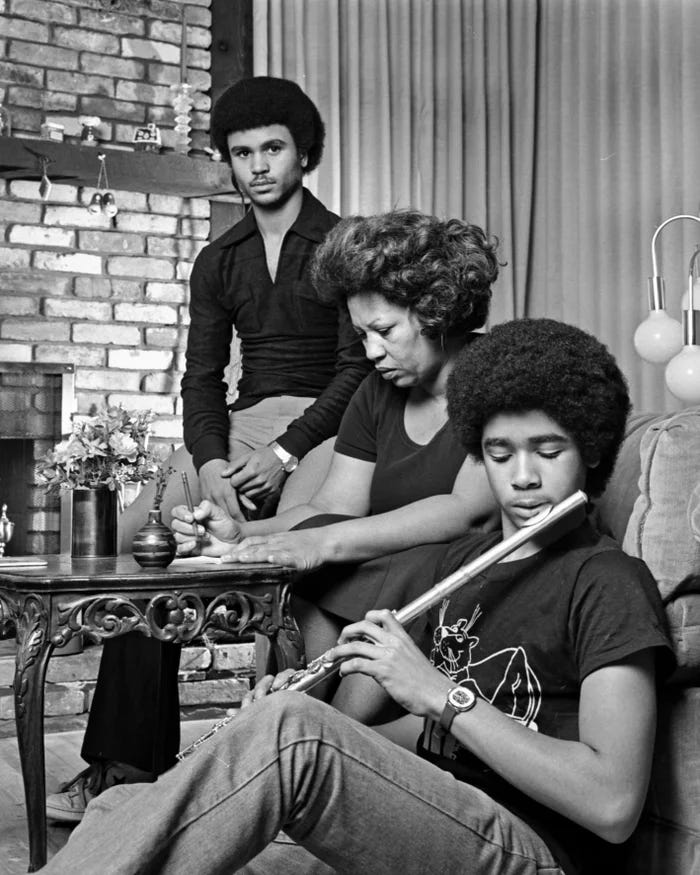
Inadvertently, the last two episodes of Deep Read have been with women who are building family businesses and embracing a fully integrated vision of working family life. Both Sandeep Salter (co-founder of Salter House; Deep Read #53) and Trinity Mouzon Wofford (writer and co-founder of Golde; Deep Read #54) spoke to me about how they have deliberately constructed careers in which the family unit is the organising principle, rather than an obstacle to be worked around. This isn’t an arrangement that can work for everyone – it typically requires a certain amount of flexibility and external support that isn’t available to all working mothers – and nor would it suit every disposition. But as a still relatively new mother myself (my daughter is two and a half), I’m always looking to my peers and friends for insight on ways of making it all work.
Decades after mothers (who have always worked) entered the paid workforce en masse, the nuances of working parenthood continue to be a subject of fierce debate. Multi-millionaire entrepreneur Emma Grede recently caused a furore when she declared herself a “three-hour mum,” saying she spends no more than three hours a day with her four children, weekends included. I watched the backlash unfold online with some bemusement. While I commend Grede’s willingness to admit that she does not, in fact, “do it all,” her personal solution - outsourcing parenting duties, presumably via paid live-in childcare - isn’t a viable one for any working mother I know, and therefore feels more irrelevant than it is controversial. Emulating the parenting hacks of someone in the 0.01% seems about as useful as asking Grede for her favourite 30-minute dinner recipe: obviously she has a full-time chef as well.
The messages women receive about how to conduct our careers postpartum are disorienting then, and consistently unhelpful. At the risk of stating the obvious, the entire dynamic of your career shifts the moment your paid job is no longer your foremost responsibility – and yet our society, and especially our economy, expects you to keep operating as if it were.
Your energy, availability, and focus all shift too. And if you’re self-employed, a founder, or simply working in an industry with a socialising imperative (marketing, PR, events, the arts, etc.), you’re expected to be available in the evenings – typically right around the time you’d otherwise be doing the bedtime routine. If there’s any public-facing aspect of your work – and this is true of a growing number of us – you’ll likely feel pressure to look as if you don’t have children (rested, groomed, camera-ready) at all times. It can feel like an impossible conundrum, and there isn’t much useful information out there on how to approach it.
Not long after I gave birth, a successful artist and mother of three said something that has stuck with me: